
Direct, indirect, or both: the first decision
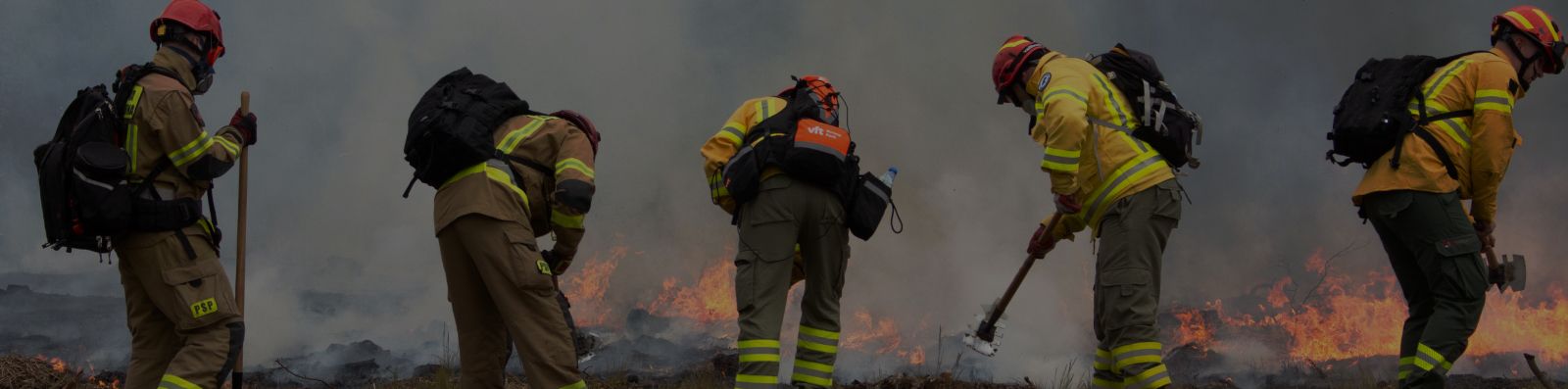
Seeing the flame and wanting to put it out right there. It's the most natural instinct in the world, and also one of the most frequent mistakes on the ground: heading straight for where the fire is visible, without stopping to assess whether that is really the correct position —or the safest one— to face it.
Because fighting a wildfire isn't just a matter of how much force you throw at it, but a prior decision that shapes everything else: do I attack the flame where I currently find it, or do I fall back to a position I choose and let the fire come to meet the obstacle I've prepared? That is the difference between direct attack and indirect attack, and it's not a minor technical nuance: the safety of the suppression teams, the efficient use of resources, and ultimately whether the fire is contained or keeps gaining ground all depend on this decision.
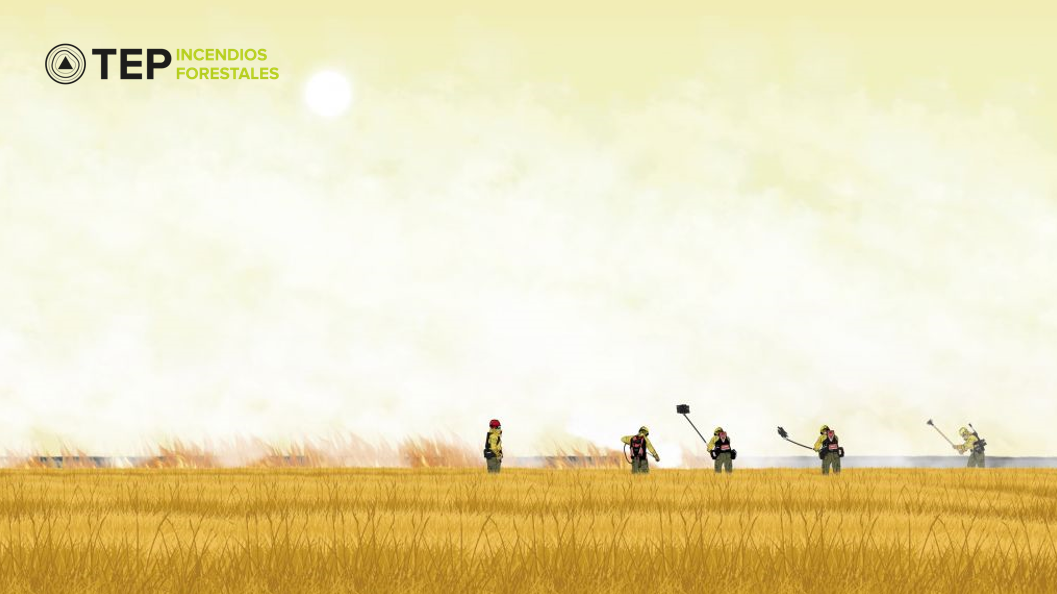
The choice between the two options shouldn't be a matter of habit or convenience. It should be made using data: rate of spread, flame length, topography, wind, access. And often the answer isn't choosing one or the other, but combining them: splitting the operation into teams that attack directly where the fire allows it, and others that, in parallel, prepare a discontinuity further from the fire front. Direct and indirect attack aren't interchangeable or mutually exclusive styles, but approaches suited to different conditions, sometimes coexisting in the same fire — and confusing them is one of the most common risks in an operation.
Wind, slope and fuel: what to assess before deciding
Before talking about manoeuvres, it's worth looking at what governs a wildfire's behaviour on the ground. Three spread factors are at play: wind, slope and available fuel. When these factors align, the fire behaves with greater intensity and speed; when they don't, its behaviour is reduced.
That behaviour translates into two variables that any suppression commander should assess before mobilising a single unit: flame length, as an indicator of intensity, and rate of spread.
Ignoring this analysis leads to an overly simple response: directly attacking the visible flame without anticipating where the front will advance, or checking whether the deployed resources can work effectively and safely. When the fire exceeds that capacity, it ends up escaping containment attempts.
Both variables allow you to determine whether a front is within or beyond what is known as suppression capacity: the relationship between fire behaviour and the real capacity of the resources available to intervene.
Being beyond capacity means that the fire's energy, speed or dynamics exceed what the resources deployed at that place and time can handle. Under those conditions, pressing on with the attack doesn't increase effectiveness — it prolongs exposure and raises the risk that the fire will overwhelm, surround or compromise the resources.
Suppression capacity is not constant either. It can change with a shift in wind, an alignment with the slope, an increase in fuel continuity, the arrival of new resources, or the loss of a window of opportunity. That's why analysing it isn't only about deciding whether a front can be attacked, but about identifying where, when and with what manoeuvre it's possible to intervene safely and effectively. This dynamic, context-dependent operational limit is the central concept running through this entire article.
Direct attack: working on the flame itself
A direct attack consists of physically acting on the edge of the fire, attacking one of the three sides of the fire triangle: for example, smothering (removing the oxidiser) or cooling, right on the active perimeter, stopping the flame exactly where it is.
Historically, it's the oldest and also the most intuitive method: fighting the fire where it is. It's carried out with a wide variety of tools depending on the type of behaviour:
- Hand and power tools —fire swatters, water backpacks, blowers, or Gorgui-type Vallfirest tools, a multi-function tool designed to combine several of these functions (cutting, digging, smothering) in a single piece, or Vallfirest's extinguisher backpacks, which allow crews to work autonomously with pressurised water without depending on a hose lay.
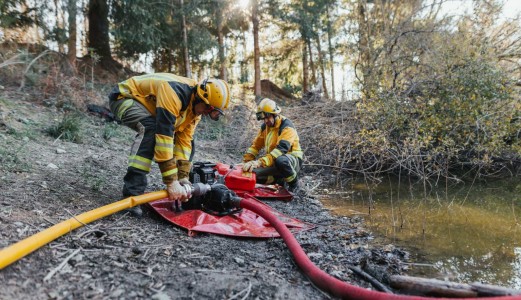
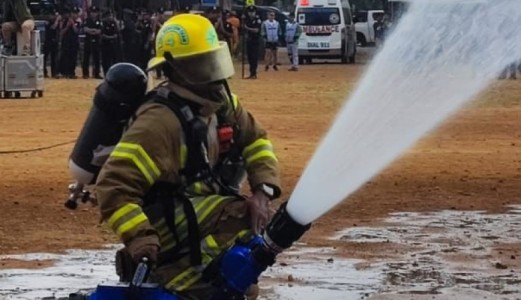
- Water line, with hose lays or moving-attack extinction from an engine, fed by Vallfirest portable pumps drawing directly from a natural or portable water point. A multi-function nozzle such as Vallfirest nozzles allows switching between straight stream, fog pattern and protection mode without changing tools mid-manoeuvre.
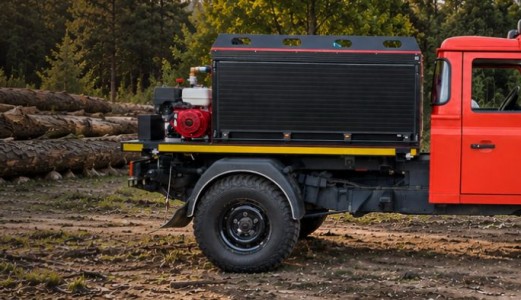
- Vehicle units, such as Vallfirest Skid Units, mounted on pick-ups or light/heavy support vehicles integrating a tank and pump on a light vehicle for moving-attack work, or the Vallfirest Tactical Unit, a multifunctional, interchangeable module that turns the vehicle into a complete wildland firefighting resource.
- Aerial resources, applying water or foam directly onto the base of the flames to reduce intensity and support ground crews, using buckets such as the Vallfirest Water Hog, adaptable to any helicopter and fitted with a variable discharge valve to regulate the volume of water on each pass.
- Light and heavy machinery, such as the Dronster, a multipurpose robot able to handle far greater flame lengths —up to 8 metres or more— thanks to its ability to remove fuel or smother with earth at high advance speed.
In day-to-day operations, these tools are often used separately, but sometimes the situation demands gaining capacity and speed, or facing higher-intensity fronts, and that requires stepping up to a simultaneous deployment of manoeuvres on the same sector: adding and layering different capabilities on the same flank —hand tools, a water line, aerial resources. This is precisely what The Emergency Program (TEP) calls combined manoeuvres, another key concept in this article. In reality, however, this is one of the weakest points of many operations: many organisations, for historical or cultural reasons, or simply because of how they were formed, keep reaching for the same tool they've always used, at a moment in history when wildfires themselves have evolved. It's necessary to update and adapt to these new challenges.
The effectiveness of aerial resources in support of direct attack also depends on having water available close to the work area. Units such as the Vallfirest Heliskid —a large-capacity foldable tank with an integrated pump, helicopter-transportable to points with no road access— or Vallfirest inflatable tanks allow temporary water points to be set up: they're filled by aerial drop (for example, with a bucket like the Water Hog) and then feed pressurised hose lines for direct ground attack, without relying on an engine driving along tracks.
Among the advantages of direct attack:
- It allows crews to act directly on the flames and halt the fire's advance at the very moment the manoeuvre is carried out.
- It limits the burned area, because the work happens on the perimeter and no ground is sacrificed.
- It offers a clear visual reference of the perimeter and of the already-extinguished area, which makes it easier to control the manoeuvre.
Its limitation, however, isn't always as clear on the ground as it should be. In theory, direct attack should only be applied within the available suppression capacity: if the flame length or rate of spread exceed what the tool and the crew can safely handle, the manoeuvre stops being viable. In practice, though, it's common to see suppression teams positioned on the fire front in conditions that clearly exceed that capacity —out of habit, operational pressure, or simply because no one has stopped to calculate it. That gap between theory and what actually happens on the ground is probably the most important risk associated with direct attack.
Indirect attack: getting ahead of the fire
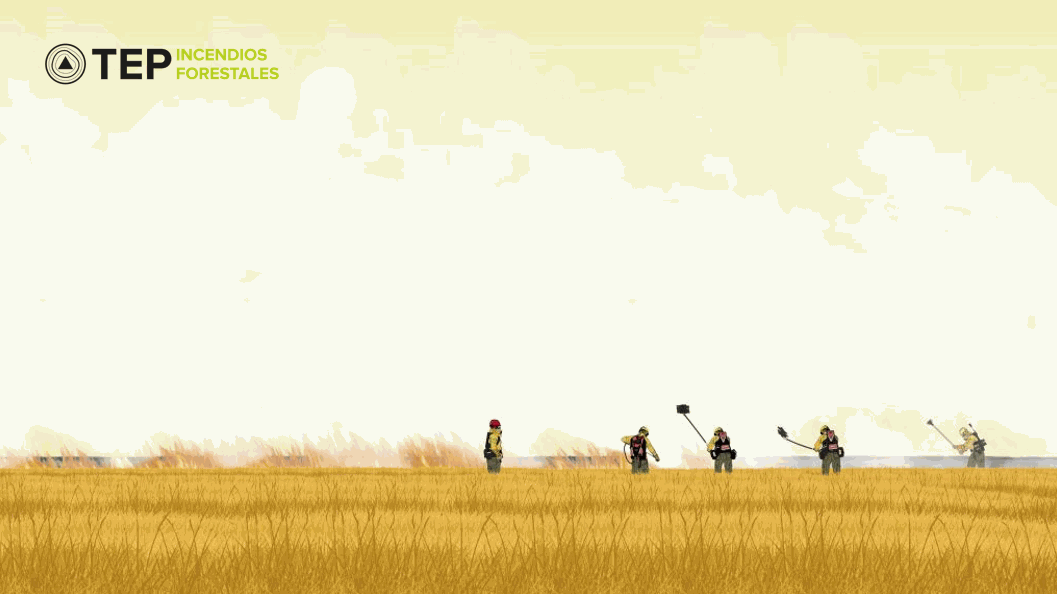
When a fire front exceeds the available suppression capacity —due to intensity, speed, or both— the strategy changes in nature: it's no longer about smothering the flame where it is, but about finding a new suppression opportunity, a point on the ground where it's actually possible to position safely and carry out a manoeuvre that helps stop the front or, at least, slow it down and regain capacity. In indirect attack, crews don't work on the fire itself, but ahead of it, at a safe distance, building a fuel discontinuity so that the fire itself meets an obstacle already prepared.
- Mechanised control lines, opened with light or heavy machinery, with hand tools, or by widening existing tracks or roads, clearing vegetation along a strip wide enough to act as a discontinuity. The Vallfirest Dronster, a remote-operated multipurpose robot, makes it possible to open these lines in hard-to-reach terrain or in conditions of high risk to personnel, without needing to expose a suppression crew on the work strip.
- Long-term retardant drops from aerial resources, applied in advance in higher or gentler-sloped areas, ahead of the front's expected advance.
- Backfiring and burnout operations (prescribed fire), in which fuel between the control line and the main front is removed in a controlled way, widening the safety margin and shaping fire behaviour before it arrives. Ignition of these support burns is carried out with tools such as the Vallfirest drip torch, which allows the fuel drip to be dosed and controlled during ignition. The ignition team always works alongside control tools —Vallfirest water backpacks or fire swatters— to reinforce the safety margin and contain the burn if its behaviour accelerates beyond what was expected.
The advantage of indirect attack lies mainly in the margin it offers against uncertainty: it doesn't depend on pinpointing exactly where the front will be at every moment, nor on calculating its behaviour by the second, but on preparing a line that the fire will, sooner or later, have to cross. This also buys time: while the line is being prepared, there's room to reposition resources, wait for the front to lose alignment with wind or slope, or simply reassess the situation without exposing the crew to the active perimeter.
Its cost is equally real. It means sacrificing ground —the area between the control line and the original front will burn regardless— and it demands a different approach to safety management, since the crew works some distance from a front whose behaviour can change before it arrives. There's also a specific added risk: spot fires. Embers can jump the control line before the main front reaches it, especially in high-intensity fires, which means the terrain beyond the line also has to be watched, not just the front that's visibly approaching.
The difference that really matters: the safety margin
Beyond the physical distance from the flame, the underlying difference between the two strategies is the source of the suppression crew's safety.
In direct attack, safety comes from working next to an already-burned area, which acts as a natural refuge. In indirect attack, that safe zone doesn't exist yet: it has to be built, and until the control line is closed and the fire has reached it, the crew operates in a scenario of greater uncertainty. That's why, in practice, many of the more advanced manoeuvres —such as supporting prescribed fire or burnout operations— exist precisely to reduce that uncertainty before committing crews.
Not two opposing approaches, but one continuum
It would be a mistake to think of direct and indirect attack as two rival tactical schools. On the ground, the same fire can require both methodologies simultaneously in different parts of its perimeter: direct attack with hand tools at the tail, while a burnout is being prepared on a track the head of the fire is advancing towards; and on one of the flanks, a moving attack is carried out, mopping up and securing the front.
The right decision doesn't depend on a tactical preference, but on a correct and constant reading of fire behaviour: flame length, rate of spread and opportunities. That reading is what separates an effective manoeuvre from a lucky one, and it's also why the wildland firefighter's toolbox —from the simplest fire swatter to a high-pressure water line— is so broad: every scenario demands an efficient and intelligent use of the many resources available, whether working on the flame itself or getting ahead of it with a control line.
Frequently asked questions
What is the main difference between direct and indirect attack?
Direct attack acts on the flame itself, on the fire's active perimeter. Indirect attack acts at a distance from the flame, building a discontinuity line ahead of the front to stop it —or slow it down— when it arrives.
When is indirect attack used instead of direct attack?
When flame length or rate of spread exceed the safe suppression capacity of the available resources, or when the terrain doesn't allow safe access to the fire front.
Is direct attack always faster than indirect attack?
Not necessarily. Direct attack tends to win on speed when it's within suppression capacity, because it doesn't sacrifice ground or require building a new line. But beyond that capacity, indirect attack doesn't automatically win either: within indirect attack there are very different methods in terms of execution speed. A control line opened by hand can be much slower than a technical fire manoeuvre carried out at a distance (backfiring or a burnout), which under the right wind and fuel conditions can resolve an entire flank in minutes. The right question isn't so much "which is faster?", but which method —within each option— best fits the front's rate of spread, the resources available, and safety.
Can both strategies be combined in the same fire?
Yes, and it's the norm in fires of any significant size: different flanks or parts of the same perimeter can require different strategies depending on their specific behaviour at any given moment.

Article written with the support of TEP.