
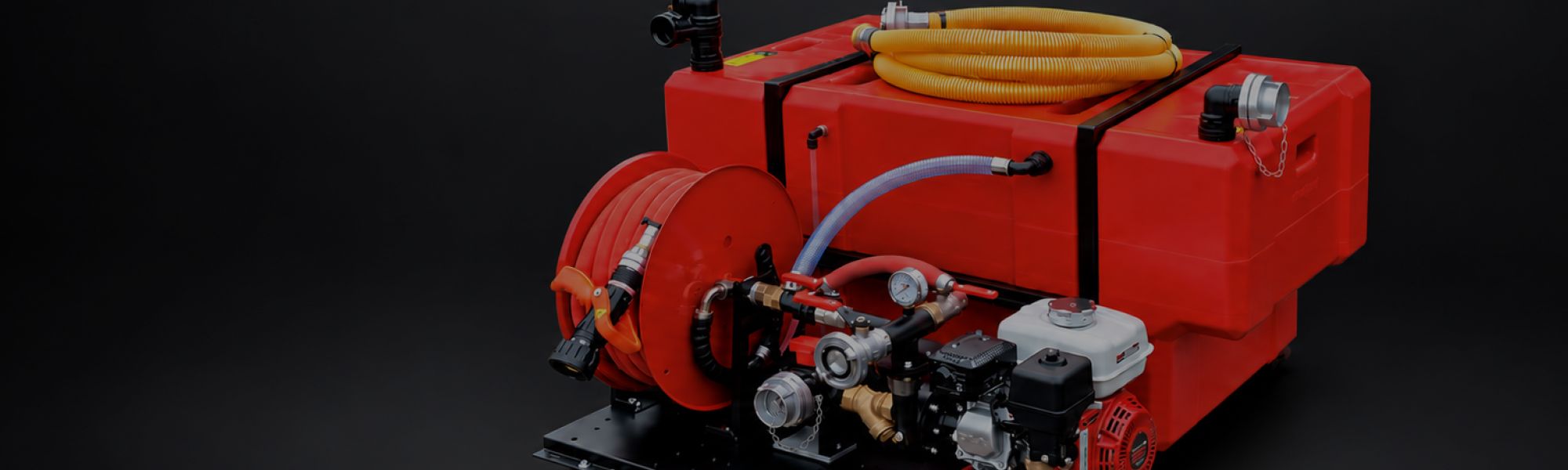
The BH1 kit has long been the benchmark entry point for equipping a pickup truck with a firefighting kit: simple, light and reliable for a fast, uncomplicated response. But not every operation has the same needs, and some need more direct-attack flow without taking on the extra weight, cost and complexity of the BH3 kit. Vallfirest introduces its new BH1-160 firefighting kit: the natural evolution of the BH1 model, with the same pump and the same ease of use, but with a more powerful engine that lifts performance to 330 l/min and 10.9 bar.
A solution between the BH1 and BH3 options
Vallfirest's range of centrifugal-pump firefighting kits is built on a single architecture —vertical polyethylene tank, metal frame, hose reel— combined with different engine-pump units. The entry-level BH1 handles light response well: manual start, low weight, contained cost. The BH3 was designed for the opposite end: high pressure with electric start, intended for long hose lays or large elevation differences. Between the two, many operations need more direct-attack flow than the BH1 delivers, without needing the pressure or the weight jump of the BH3. The new BH1-160 fills that gap with concrete figures, in its two engine options and the three tank capacities available:
| Model | Engine | Pump | Max. pressure | Max. flow | Start | Weight 400 L | Weight 500 L | Weight 600 L |
|---|---|---|---|---|---|---|---|---|
| BH1 – Centrifugal | Honda GXH50 · 2.1 HP | VFT_1SP4 | 6.9 bar | 260 l/min | Manual | 122 kg | 127 kg | 134 kg |
| BH1-160 – Centrifugal | Honda GX160 · 4.8 HP | VFT_1SP4 | 10.9 bar | 330 l/min | Manual | 137 kg | 142 kg | 149 kg |
| BH1-160 – Centrifugal | B&S XR6,5 · 6.5 HP | VFT_1SP4 | 10.9 bar | 330 l/min | Manual | 138 kg | 143 kg | 150 kg |
| BH3 – Centrifugal | B&S XR10 · 10 HP | VFT_3SP | 16 bar | 270 l/min | Electric | 163 kg | 168 kg | 175 kg |
The figure worth underlining: the BH1-160 delivers more flow than the BH3 (330 versus 270 l/min) while adding only 15–16 kg over the entry-level BH1 at any tank capacity, compared with the 40 kg or more required to step up to the BH3 —which also adds electric start and a different pump (VFT_3SP instead of VFT_1SP4). The BH1-160's two engine options, Honda GX160 and B&S XR6,5, are practically equivalent in performance and weight (barely 1 kg apart), so choosing between them usually comes down to engine-brand preference or spare-parts availability rather than any real operational difference. If the operational priority is sustained water volume in direct attack, rather than pressure for long hose lays or large elevation differences, the BH1-160 kit delivers it without that cost in weight, complexity or maintenance.
What really changes: same pump, more powerful engine
The BH1-160 does not replace the BH1; it evolves it: it uses exactly the same VFT_1SP4 pump, and only the engine unit changes. It is available with two engine options of equivalent performance —Honda GX160 or B&S XR6,5—, reaching the same 10.9 bar and 330 l/min. Both keep the BH1's manual start, with no need for a battery.
Available across the whole tank range: 400, 500 and 600 litres
As the table above shows, the BH1-160 kit is not tied to a single tank capacity: it mounts equally on the three vertical polyethylene tank sizes —400, 500 and 600 litres—, with the same fixing system and the same mounting dimensions across the range. This lets you size a fleet by water autonomy without giving up the BH1-160's jump in flow, and move up to a larger tank later without changing kit family or installation procedure.
Water autonomy: suction, pressure filling and draining
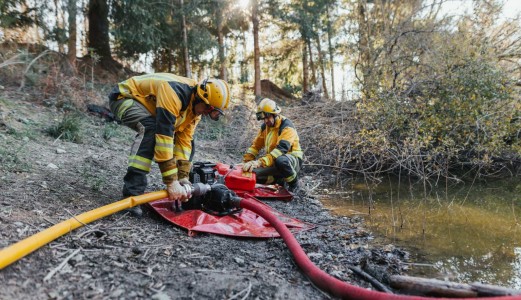
The polyethylene tank —made in one piece by rotational moulding, with 8 mm wall thickness and two internal baffles that damp the inertia of moving water— can be refilled in two ways: under pressure, through the 1-1/2" filling port on the top surface, connected to a hydrant or an external pump; or by suction, using the supplied 5 m suction hose —with non-return foot valve, built-in strainer and Storz coupling— to draw water from any unpressurised source: a pond, a river or a portable tank. A 3/4" drain allows the tank to be emptied completely for storage or to protect the pump from freezing in cold climates, and the sight-tube level indicator shows at a glance how much water is left.
Hose reel and direct attack on the move
The BH1-160 comes as standard with a manual hose reel carrying 20 m of DN25 semi-rigid hose (40 bar), with a crank handle and locking system, designed so that a firefighter can work the nozzle while the vehicle advances slowly alongside the fire line —the most characteristic use of a skid unit compared with a portable pump carried by hand. With 330 l/min available, that manoeuvre gains real margin over the standard BH1: more water per pass before having to refill or change tactics. The kit also supports optional foam proportioner systems, both "through the pump" and Venturi-effect, to work with foam concentrate without losing mix stability.
Which kit to choose: BH1, BH1-160 or BH3
- BH1 kit: fast, simple response as a support fleet or for secondary vehicles where weight and manoeuvrability are the priority.
- BH1-160 kit: initial-attack unit that needs more sustained flow, without taking on the weight, electric start and cost of the BH3 — the middle ground for most quick-response vehicles.
- BH3 kit: operations that prioritise high pressure over flow, such as long hose lays or significant elevation differences, where the 16 bar and electric start make the difference.
Choosing among the three is not a matter of “more is better”, but of which variable —flow or pressure— really decides the outcome of the manoeuvre in the terrain where each fire service operates. The BH1-160 exists precisely because, for a large share of initial-attack operations on a pickup, that variable is flow, and getting it should not mean carrying 40 kg more or a different pump.
Frequently asked questions
How does the BH1-160 kit differ from the standard BH1 kit?
The BH1-160 uses the same VFT_1SP4 pump as the BH1 but with a more powerful engine —Honda GX160 (4.8 HP) or B&S XR6,5 (6.5 HP)—, raising performance from 6.9 bar and 260 l/min to 10.9 bar and 330 l/min.
Why choose the BH1-160 instead of going straight to the BH3?
The BH1-160 kit delivers more flow than the BH3 (330 versus 270 l/min) while adding only 15–16 kg over the entry-level BH1, compared with the 40 kg or more and the electric start that the BH3 requires. The BH3 kit makes sense when the operational priority is pressure —16 bar versus 10.9 bar— for long hose lays or large elevation differences.
Which engines does the BH1-160 kit use?
Two options that are practically equivalent in performance and weight: Honda GX160 (137–149 kg depending on tank) or B&S XR6,5 (138–150 kg), with 10.9 bar maximum pressure, 330 l/min maximum flow and manual start.
Is it available with different tank capacities?
Yes. The BH1-160 mounts on the three vertical polyethylene tanks in the range —400, 500 and 600 litres—, with the same fixing system and mounting dimensions. Weight ranges from 137 kg (400 L) to 149–150 kg (600 L), depending on the engine.
Can the tank be refilled without stopping the operation?
Yes, in two ways: by connecting a hose to the 1-1/2" filling port from a hydrant or an external pump, or by using the kit's own 5 m suction hose to draw water from an unpressurised source such as a pond or a river.
Can it be used to attack the fire while the vehicle is moving?
Yes. The reel with 20 m of semi-rigid hose is designed precisely for this manoeuvre: it lets a firefighter work the nozzle while the pickup advances slowly alongside the fire line.
Does it include a foam system?
The foam proportioner is an optional system, available in "through the pump" or Venturi-effect versions, with a manual proportioning selector valve to keep a stable foam mix.
What warranty does the BH1-160 kit have?
The equipment carries a 2-year warranty, covering the complete firefighting kit manufactured by Vallfirest.