
An incorrectly sized inflatable tank creates two different problems depending on which way the error goes: insufficient infrastructure, if the usable volume does not cover the water consumption of the operation, and unnecessary logistics, if a larger unit than the operation requires is transported and set up.
Vallfirest inflatable water tanks are designed to create remote water points, with much shorter and simpler set-up than traditional metal frame tanks and more efficient performance than floating-collar tanks. The right capacity depends on four variables: the area to be covered, the loading method, the flow rate of the fire pump and the ease of transport required by access to the deployment site.
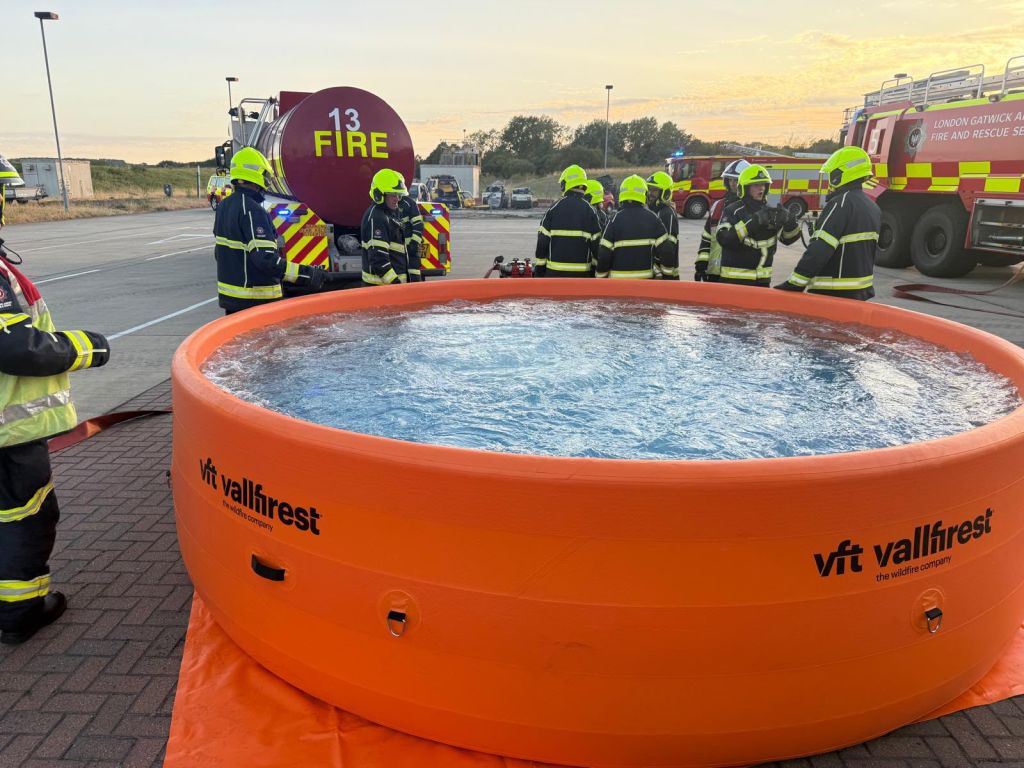
Vallfirest inflatable tank range: technical specifications
The range covers five nominal capacities, from 3,000 to 56,000 liters, made of 2,600 g/m² PVC with a double protective layer on the top ring against bucket impacts and a blue double-layer floor.
| Model | 3,000 L | 790 gal | 7,000 L | 1,850 gal | 12,000 L | 3,170 gal | 25,000 L | 6,600 gal | 56,000 L | 14,800 gal |
|---|---|---|---|---|---|
| Reference | DED5705-20003 | DED5705-30007 | DED5705-30012 | DED5705-30025 | DED5705-30056 |
| Usable capacity | 2,827 L | 747 gal | 6,360 L | 1,680 gal | 11,310 L | 2,988 gal | 22,620 L | 5,976 gal | 50,930 L | 13,454 gal |
| Diameter | 2 m | 6.5 ft | 3 m | 9.8 ft | 4 m | 13 ft | 4 m | 13 ft | 6 m | 20 ft |
| Usable height | 90 cm | 90 cm | 90 cm | 1.8 m | 1.8 m |
| Weight | 31 kg | 68 lbs | 43 kg | 95 lbs | 78 kg | 171 lbs | 105.5 kg | 232 lbs | 173.5 kg | 382 lbs |
| Folded dimensions | 90x35x35 cm | 90x45x45 cm | 120x63x63 cm | 160x70x70 cm | 170x113x90 cm |
| Inflation time | 1 min | 1 min | 2 min | 3 min | 4 min |
| Connections | 2 × 2" threaded | 2 × 3" threaded | 2 × 3" threaded | 2 × 3" threaded | 2 × 3" threaded |
3,000 to 12,000 L tanks: fast water points with light deployment
Weighing 31 to 78 kg and inflating in 1 to 2 minutes, these three models fold into the most compact dimensions in the range (up to 120x63x63 cm). The 3,000 and 7,000 L models (31–43 kg) can be carried by hand; the 12,000 L model (78 kg) is already close to the limit of what can be handled manually, so it is more practical to deploy with a light vehicle. The 3,000 L model is fitted with 2" threaded connections, while the 7,000 and 12,000 L models already incorporate the 3" connections common to the rest of the range.
25,000 and 56,000 L tanks: large volumes for sustained operations
From 25,000 L upwards, the usable height increases from 90 cm to 1.8 m and the usable capacity exceeds 22,000 L, which reduces refill frequency in continuous loading operations. The 56,000 L model, with a 6 m diameter and a dry weight of 173.5 kg, is the highest-capacity configuration in the range, designed for remote water points that must sustain multiple loading cycles without constant refilling.
How to choose the right capacity
Applying the four variables above to the specification table, the selection comes down to checking four specific points:
- Area to be covered: the higher the water consumption between refills, the greater the usable capacity of the tank must be.
- Loading method: for ground loading by fire pump, any diameter is valid. For aerial loading with a helicopter bucket or with a drone loading system such as the Water Hog from the VFT Aerial division, the relevant variable is the tank height, not the diameter: the 25,000 and 56,000 L models, at 2 m high, allow practical use of aerial buckets.
- Fire pump flow rate: a low flow rate means longer filling times when the tank has to be refilled from an external source; it is advisable to compare the available flow rate with the usable capacity before oversizing.
- Ease of transport: if access is on foot, the 3,000 and 7,000 L models (31–43 kg, folded ≤90x45x45 cm) are the only ones that can be carried without mechanical means; the 12,000 L model (78 kg) is already close to the limit of what can be handled manually, and from 25,000 L (105.5–173.5 kg) deployment requires a vehicle and several operators.
Which one do I need? Quick summary
| If you need… | Consider… |
|---|---|
| Manual transport | 3,000–7,000 L |
| Compact water point | 3,000–12,000 L |
| Greater autonomy | 25,000–56,000 L |
| Large volume / multiple cycles | 25,000–56,000 L |
| Aerial loading (bucket or Water Hog)* | 25,000–56,000 L |
* Suitability for aerial loading depends on the tank height (2 m on these models), not the diameter; subject to operational validation with the specific loading method.
The tank within the system: fire pump, hoses and aerial loading
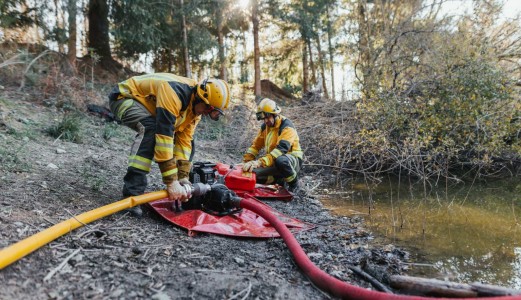
The inflatable tank does not work in isolation: it is the central element of a remote water point that connects the water supply source with the final loading method. Each tank incorporates an internal suction section and 2" or 3" threaded Camlock connections depending on the model, through which a fire pump can draw water from the tank once it is full. For this suction, Vallfirest offers flexible PVC spiral suction hoses in two diameters —DN50 (2") and DN40 (1 1/2"), both 5 m long— together with Camlock-NPSH and Camlock-Storz adapters that match the pump thread to the tank connection.
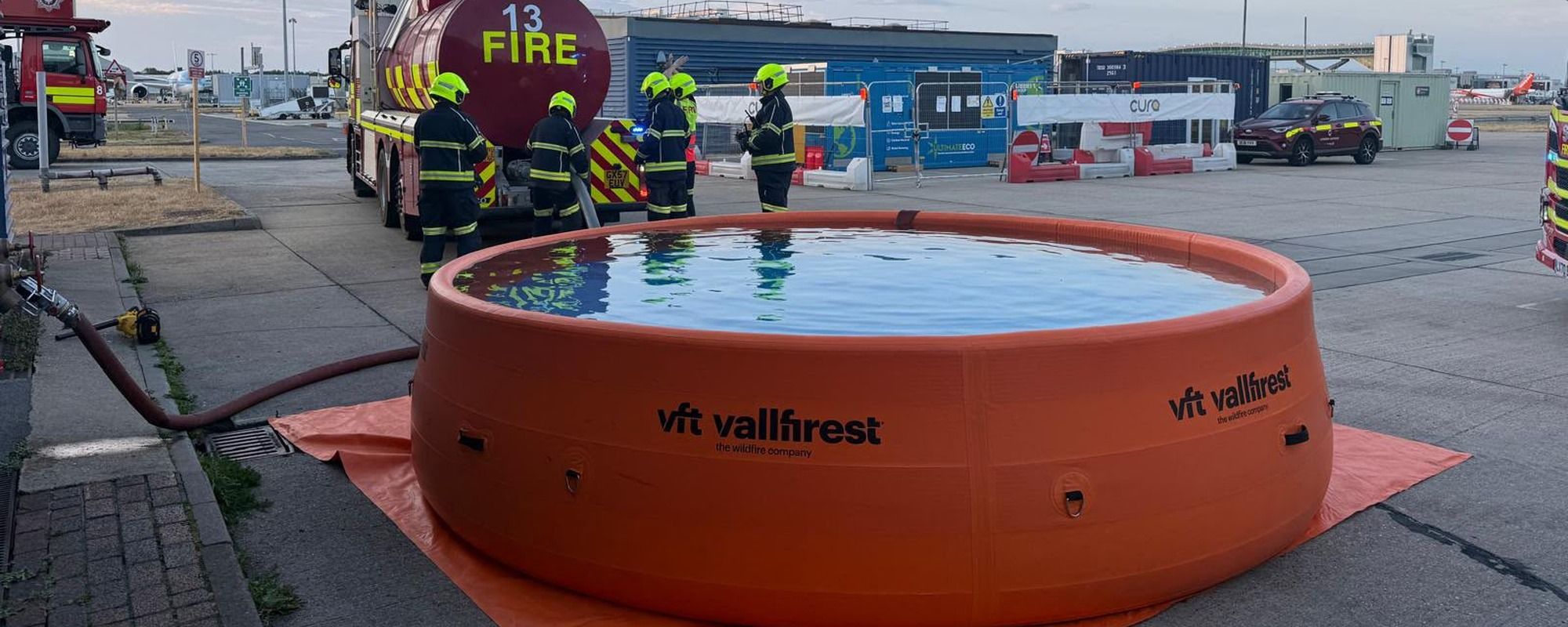
The tank makes operational sense when the original water source cannot be used directly by the loading method: due to insufficient depth or accessibility for a bucket, because it is a small watercourse not accessible by helicopter, or because there is no source available and only a water tender can supply water. In these cases, the tank acts as an intermediate point: it is filled from the original source using coupled lay-flat hose —for example, from a fire engine— and, once full, allows direct dipping by the helicopter bucket or the Water Hog, without these having to access the original source.
When the source does meet the requirements of the loading method —a pond of sufficient depth, for example— there is no need to introduce the tank as an intermediate step: the bucket can dip directly from the source, and a fire pump can draft from it without going through the tank.
In summary
The capacity of an inflatable tank is not defined by the theoretical maximum volume of the tank, but by the real working cycle of the water point: how much needs to be stored, which method is used to load it, at what flow rate it is refilled and with what means it is transported to the site. Sizing the tank together with the fire pump and the loading method —ground or aerial— as a single system, rather than as independent components, is what determines whether the water point sustains the operation without becoming a bottleneck.
The full technical data sheet, with details of the components included, is available on the Vallfirest inflatable water tanks product page. To size the tank for a specific operation —including its combination with the right fire pump— you can request information or a quotation through the same page.
Frequently asked questions
What is the difference between nominal capacity and usable capacity?
Nominal capacity is the theoretical volume of the tank filled to the brim (for example, 25,000 L); usable capacity is the volume that can actually be used. In the 25,000 L model, for example, the usable capacity is 22,620 L. This difference applies to all five models in the range and is detailed in the specification table.
How long does it take to set up an inflatable tank?
With the electric blowers included (1200 W), inflation time ranges from 1 minute for the 3,000 and 7,000 L models to 4 minutes for the 56,000 L model. The battery-powered DeWalt portable blower is not intended to replace this process on large tanks: its main function is to provide the final pressure once the tank is already inflated. As a full inflation method, it is only practical on models up to 12,000 L when no generator is available —with considerably longer filling times, in the order of 10–15 minutes— while on the 56,000 L model it is not a viable alternative, as it would take more than 30 minutes and several batteries.
Can I transport the tank without a vehicle?
The 3,000 and 7,000 L models, weighing 31 to 43 kg with folded dimensions of up to 90x45x45 cm, are the ones that allow practical manual transport. From 12,000 L (78 kg) the weight is already close to the limit of what can be handled manually, so from this capacity upwards deployment requires a vehicle.
How is the tank connected to the fire pump?
The tank is connected to the fire pump using DN50 (2") or DN40 (1 1/2") spiral suction hoses, 5 m long, with Camlock-NPSH or Camlock-Storz adapters depending on the pump suction: it is the pump that draws water from the tank to supply, for example, a hose lay. If, on the other hand, the tank needs to be filled, the connection is made with discharge hose —not with these suction hoses— usually from the equipment supplying the water (such as a fire engine).
Can the tank be used as a dip point for a helicopter bucket or the Water Hog?
Yes, although in practice this depends on the tank height: the 25,000 and 56,000 L models (2 m high) allow practical use with a helicopter bucket or the Water Hog.
What is included with the tank besides the tank itself?
Repair kit, anchoring kit (straps, stakes, carabiners and hammer), air blowers, battery-powered DeWalt portable blower with battery and charger, pressure gauge, square protective groundsheet, transport bag and Camlock cover bag; the exact quantities of each component vary by capacity, as detailed in the technical data sheet.
Images courtesy of our distributor Fire Hosetech.