
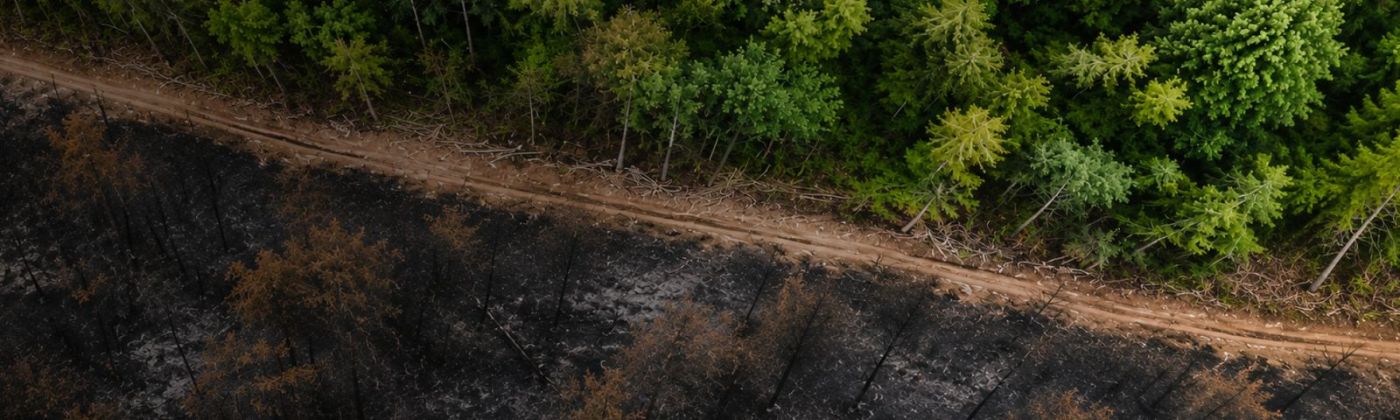
Every fire line starts with a prior question: what do we want to do, and what can we actually do? The operational reasoning behind fireline work starts from that distinction before deciding how to open the line: by hand, with machinery, or by combining both. In this article we review that reasoning and the two most common ways of mechanising it in the field: hand tools and heavy machinery.
This article has been prepared with the technical content of TEP, The Emergency Program, a training programme specialised in wildland fires.
Operational reasoning: what we want to do and what we can do
Before deploying any manoeuvre, tactical analysis relies on four chained questions: what the fire wants to do (the potential given by its spread factors), what the fire can do (the real impact of that behaviour on its movements), what I want to do (tactical objectives and their priorities) and what I can do (the windows of action, position, capacity and manoeuvres available in the toolbox).
This reasoning gives rise to the concept of the optimal tactical manoeuvre: the one that achieves the tactical objective through the simplest and most efficient execution, using only the resources needed and prioritising speed, safety and minimum operational effort to stabilise the perimeter. Checking whether the optimal manoeuvre we have visualised is feasible with the resources available is the second step; if it is not, the optimal manoeuvre that can really be executed is applied.
That calculation rests on the window of action: the space and the moment in which fire behaviour offers a real opportunity to work effectively, its weak point and our strong point. It is framed within what is known as tactical architecture: the analysis of all possible operations within a single tactical objective, from which the most robust option is chosen, that is, the one that provides the most certainty and is the most realistic in terms of position and capacity.
This reasoning, what we want to do and what we can do, is what determines, on the ground, whether the fire line is built with hand tools, heavy machinery or a combination of both. Let us start with the first option in the toolbox: hand tools.
Fire lines with hand tools
Hand tools are the most versatile option in the toolbox: they depend neither on vehicles nor on prior access, only on a well-trained crew. On the ground, they translate mainly into one manoeuvre, the fire line, whose purpose is to anchor, liquidate and confine the fire perimeter, separating the black zone from the green zone. It is carried out in three steps, which can be combined depending on the fuel structure and the crew available:
| Step | Function and specification |
|---|---|
| Box opening | Needed only if the vegetation requires it. A team of chainsaw operator and swamper removes surface vegetation, and the tree layer if necessary, until a clean linear corridor is left. |
| Trench | Mandatory unless the line runs along a track, watercourse or other infrastructure already free of duff. 30 to 40 cm wide, down to mineral soil, breaking the continuity between the fuel that is going to burn and the fuel that must stay green. |
| Berm | On steep terrain or with heavy fuels that could roll, it is built on the outside of the line with as much mineral soil as possible, to hold back any material that may come loose and prevent re-ignitions. |
As a complement to the berm on slopes, cleats (small cross barriers) are used. They are placed in the trench area, angled towards the inside of the black zone, and their function is to stop incandescent rolling material from jumping the line and, if it does, to send it back towards the already burned area instead of letting it advance towards the green zone.
This manoeuvre has three main uses: as an anchor for attack, supporting technical fire operations and built quickly when there are no prior static anchors; as perimeter definition, supporting the anchoring of widening burns in the mop-up phase and finishing off low-intensity tails; and as perimeter stabilisation, when the initial attack was made with aerial resources and occasional, discontinuous line work is needed.
Each step relies on specialised hand tools. Traditionally, wildland firefighters have used tools such as the McLeod, which combines the functions of hoe and rake; the Pulaski, designed for cutting roots and working the ground; and forestry rakes, intended for removing vegetation and combustible material.
The development of the Gorgui by Vallfirest was a turning point in the evolution of these tools. Its innovative multifunction design brought cutting, digging and raking capabilities into a single head, allowing forestry crews to perform different tasks without constantly changing tools. This solution transformed the traditional concept of the hand tool, providing greater versatility, operational efficiency and adaptability to different terrain and vegetation types.
Alongside these tools, other specialised solutions complete extinguishing operations: fire swatters, used for direct attack on flames; the water backpack, which provides portable water for mop-up and cooling hot spots; blowers, which help remove leaf litter and ash during mop-up; and drip torches, used in technical fire operations such as backfires and widening burns.
Gorgui: one tool to cut, dig and rake
The Gorgui family solves the same combination of functions (narrow hoe for rocky ground, wide hoe for organic ground, rake and cutting, and McLeod-type dragging) in three different ways. The Gorgui Classic integrates the four functions in a single replaceable steel blade. The Gorgui, the original model, mounts an aluminium and titanium head with four individually replaceable blades. And the Gorgui Xtreme separates the hoe from the rake or McLeod accessories, which can be combined with different handles in up to six configurations. With any of the three, a single tool covers the three steps of the manual fire line without changing pieces.
The rest of the hand-tool box: when to use each piece
There is no universal tool for building a fire line: there is a toolbox that has to be adapted to the fuel, terrain, intensity, available time and crew capacity. Alongside the Gorgui, each piece covers a specific need:
- McLeod: combines hoe and rake in a single head; performs best in ground without stones or rock, where it lets you dig and rake in the same movement.
- Pulaski: combines axe and hoe-pick; preferred over the McLeod when you need to alternate cutting roots and wood with digging in harder or stonier ground.
- Forestry rake: removes fine surface fuel and leaf litter without disturbing the mineral soil; used for cleaning before the trench and for mop-up.
- Fire swatter: direct attack by smothering in low-intensity fires with short flames, on fine surface fuel.
- Water backpack: portable water supply for mop-up, cooling hot spots and direct support where a hose lay cannot reach.
- Blower: removes leaf litter, ash and loose fine fuel during mop-up and when preparing the line beforehand.
- Drip torch: technical fire tool, to carry out backfires and widening burns that anchor and secure the line.
| Operational need | Solution |
|---|---|
| Cut, dig and rake without changing tools | Gorgui |
| Digging and raking in ground without stones | McLeod |
| Alternating cutting and digging in hard or stony ground | Pulaski |
| Removing fine surface fuel | Forestry rake |
| Direct attack on low-intensity fire | Fire swatter |
| Cleaning and mop-up of leaf litter and ash | Blower |
| Technical fire: backfires and widening burns | Drip torch |
| Portable water for mop-up and cooling | Water backpack |
The manual fire line covers most of what a hand-tool crew can resolve on its own. But when the fuel structure, the slope or the volume of work exceed what that crew can take on within its window of action, the toolbox offers a mechanised alternative: heavy machinery.
Heavy machinery operations: mechanising the fire line
A good part of the work done with hand tools on the fireline can be mechanised with heavy machinery (HM). In direct attack, heavy machinery is the ground method with the greatest attack capacity, both for its speed of progress and for the intensities it can face, and it can increase personnel safety by creating access, safe zones and prepared spaces. Its widespread use requires better training at every level, from machine operators to incident commanders, and the introduction of roles such as the “machinery foreman” and the “head of mechanised operations”. Once set to work on the perimeter, a single machine carries out both box opening and the fire line in a matter of minutes, far more effectively than a crew of 10 or 20 firefighters.
| Type of work | Maximum slope |
|---|---|
| Downhill | 75% |
| Uphill | 55% |
| Side slope | 45% |
Putting a machine to work requires two logistical decisions before execution: the unloading point, as close as possible to where the machine will start working, and the anchor point, both for the start and the close of the line route. The whole process (activating the resource, lowboy transport, unloading, getting onto the line, planning routes and starting execution) takes an optimistic average of 3 to 4 hours, which makes heavy machinery the least agile option in the toolbox and, almost always, not a first-response resource unless makeshift machinery is already available next to the incipient fire.
In dense tree structures, when two machines are available, the tasks are shared: the first fells and knocks down trees ahead, supported if necessary by a chainsaw crew, while the second moves the material aside and shifts earth until the line is solid on mineral soil.
As a general reference value, the limit of heavy machinery is around 500 m/h and 8 metres of flame length, far beyond the capacity of a manual manoeuvre, although its slow deployment (the 3 to 4 hours mentioned above) means it must be planned in advance within the window of action, and not used as a first-response resource.
It is also worth distinguishing machinery belonging to the firefighting service from makeshift heavy machinery: agricultural tractors, skidders, skid steers, backhoes or motor graders found in the area, not intended specifically for fires, but which can voluntarily join the manoeuvre in combination with other tools. Alongside it is light remote-controlled machinery. The development of the Dronster by Vallfirest marked an equivalent leap in light mechanisation: this forestry robot, remotely operable from up to 100 metres away and fitted with a mulcher head, winch or scarifying blade, makes it possible to open fire lines in dense scrub without exposing the operator and without needing the power of a bulldozer, covering a stretch that could previously only be solved by hand or with heavy machinery.
As an example of scale, the Roboré 2019 fire (Bolivia-Paraguay) stands out, where an indirect attack was planned by opening a fire line with 4 machines advancing in parallel, as wide as a motorway. The line reached a length of approximately 80 km, built in two days of work within a window of action of 50 to 60 hours, with the aim of anchoring technical fire operations, widening the line and securing the flank between that line and the active front.
Dronster: light remote-controlled machinery for fire lines
Dronster is a remote-controlled forestry robot from Vallfirest, with a 59 HP (44 kW) diesel engine and rubber-track traction with an independent hydraulic motor on each track. It weighs about 1,500 kg without attachments, moves at 0 to 5 km/h and operates on slopes of up to 30° indefinitely, 40° for up to 7 hours and 55° for up to 30 minutes. It is operated by remote control from up to 100 m away, or up to 1 km on flat ground without obstacles, with 8 hours of battery life.
It has front, rear and top quick hydraulic couplers that allow several implements to be combined at once: a forestry mulcher and winch at the front, plus a front rescue blade; a 360° winch and a rear blade to clear fuel debris behind; and, on top, a firefighting monitor, a camera (standard or thermal) or a rescue stretcher. In wildfires it covers both passive safety (forest management and creation of safe zones) and active safety (opening fire lines and working on the perimeter), without exposing the operator, who directs the equipment from a distance.
Compared with the crawler tractor, the Dronster does not replace its large-scale opening capacity, but it covers the stretch that conventional heavy machinery does not resolve well: dense scrub, slopes or access where deploying a bulldozer is not viable or not justified by the volume of work.
From hand tool to heavy machinery: a scale of mechanisation
Between the hand tool and the crawler tractor there is a progressive scale of mechanisation, and each jump responds to a different limit from the previous one. When the terrain or the volume of work exceed what a Gorgui, a McLeod or a Pulaski can resolve by hand, and the slope or access do not yet justify deploying heavy machinery, light remote-controlled machinery, the Dronster, covers that intermediate stretch: it opens line in dense scrub without exposing the operator and without needing the power of a bulldozer. When the slope, the trees or the volume of work exceed its capacity too, the manoeuvre moves to heavy machinery. The complete sequence (hand tool, light remote machinery and heavy machinery) makes it possible to choose, at each point of the line, the level of mechanisation that matches the capacity really needed, without oversizing the resource.
From reading the fire to the line on the ground
Hand tools and heavy machinery are not interchangeable alternatives: they are two points of the same toolbox, with different speeds, intensity limits and deployment times. The choice between one, the other or a combination (mechanised box opening followed by mop-up with hand tools, for example) always responds to the same operational reasoning we started with: what the fire wants and can do, and what we want and can do within the available window of action.

Article written with the support of TEP (The Emergency Program).