

The importance of water delivery in wildfire operations.
In wildland firefighting, success is not only determined by the availability of water, but by the ability to deliver it efficiently, continuously, and at the required flow rate.
In many wildfire scenarios — especially in remote, mountainous, or infrastructure-limited areas — ensuring a reliable water supply becomes a major operational challenge.
This is where inflatable tanks play a key role.
Rapid deployment: operational in minutes
Time is a critical factor in wildfire suppression.
Inflatable tanks provide a major operational advantage by being fully deployable and ready for use in a matter of minutes. This rapid setup capability allows firefighting teams to quickly establish strategic water storage points close to the fireline.
By reducing setup time, teams can:
- Start water operations earlier.
- Adapt faster to changing fire behavior.
- Improve initial attack effectiveness.
In fast-moving wildfires, this speed of deployment can significantly impact the outcome of the operation.
Inflatable tanks as intermediate water buffers
Rather than acting as simple storage units, inflatable tanks function as intermediate buffers within the water supply chain.
They help:
- Stabilize flow rates between water sources and consumption points.
- Decouple transport and application, allowing simultaneous operations.
- Reduce dependency on direct access to natural water sources.
This buffering capacity is essential in maintaining continuous and predictable water delivery, even under variable operational conditions.
Integration with key firefighting systems
The true value of inflatable tanks lies in their ability to integrate seamlessly with other firefighting equipment, forming a coordinated water logistics system.
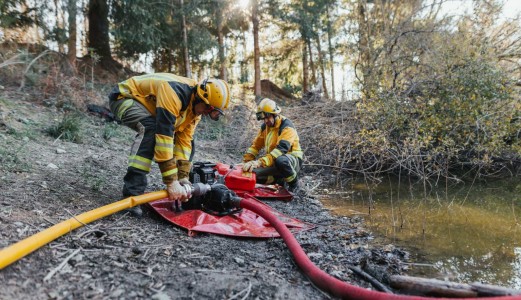
Motor pumps and relay pumping
Inflatable tanks enable efficient relay pumping configurations, particularly in complex terrain or long-distance operations.
They support:
- Consistent pressure and flow rate
- Reduced interruptions in water supply
- Greater reach from distant water sources
Aerial operations: helicopter buckets
In aerial firefighting, turnaround time directly impacts effectiveness.
By positioning inflatable tanks near the fireline, helicopters can:
- Refill faster than from distant natural sources.
- Increase the number of water drops per hour.
- Operate with greater tactical efficiency.
This makes inflatable tanks a critical asset in optimizing aerial suppression cycles.
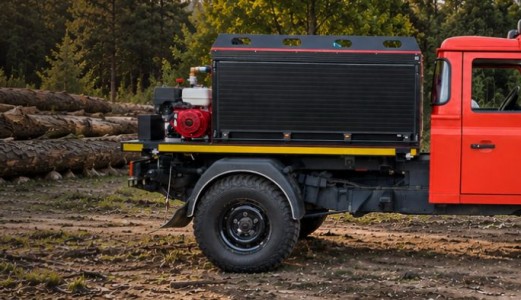
Skid units and mobile ground operations
For rapid intervention and off-road operations, water accessibility is key.
Inflatable tanks provide:
- Localized and reliable water supply.
- Increased operational autonomy.
- Greater flexibility in initial and extended attack scenarios.
This is especially valuable in areas where fixed infrastructure is unavailable.
Operational benefits
When integrated into wildfire operations, inflatable tanks contribute to:
- Faster deployment and response times.
- Improved water delivery efficiency.
- Reduced helicopter turnaround cycles.
- Enhanced coordination between air and ground resources.
- Increased safety and predictability in operations.
Conclusion: a key component in modern wildfire systems
Modern wildfire suppression requires a systems-based approach, where each component contributes to overall operational performance.
Inflatable tanks are not just water storage solutions — they are critical nodes in water logistics, enabling faster, more efficient, and more coordinated firefighting operations.
Because in wildfire suppression, it’s not only about having water —
it’s about how fast, how reliably, and how effectively it can be delivered where it matters most.