
Every fire season, the headlines focus on air tankers, helicopters and large fire engines: the visible face of wildfire suppression, and the one that draws most of the public investment.
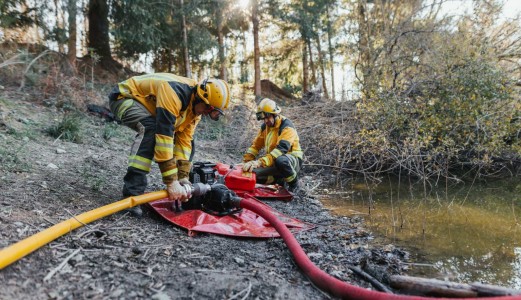
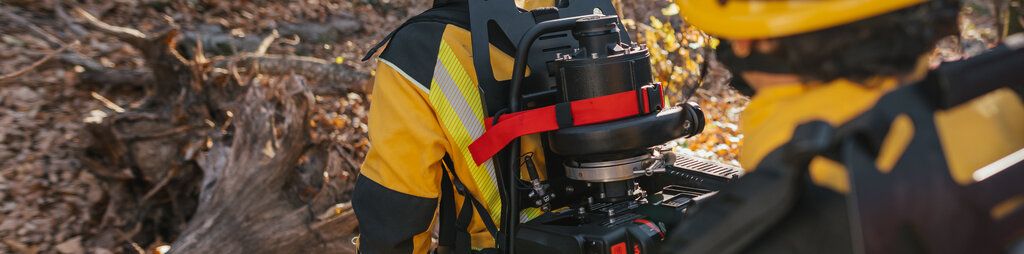
All of these resources are decisive, but none of them works alone. An aircraft or a helicopter attacks the front from the air; afterwards, or in parallel, someone has to hold the line on the ground, and that's where the crews who never make the news come in. In a ravine with no vehicle access, or on a slope with no track, the only way to get pressurized water to the front is for someone to carry it on their back. That's the territory of portable pumps: the essential complement to aerial and ground suppression wherever neither the aircraft nor the vehicle can finish the job alone.
In July 2026 we saw this first-hand: the Vallfirest technical team travelled alongside Colombia's National Fire Directorate (DNBC) through the departments of César, La Guajira, Bolívar, Magdalena, Sucre and Córdoba, training more than 120 volunteer and career firefighters in the use and maintenance of portable pumps. Six departments, many of them with areas where neither a vehicle nor a helicopter is a real option. This guide brings together what we worked on in the field: what a portable pump is, how it works, and what determines whether the water reaches the point where it's needed most with enough pressure — or not.
What is a portable pump
A portable pump is a self-contained, transportable unit made up of a combustion engine coupled directly to a pump. Its job is to drive pressurized water from a source (river, pond, tank, tanker) to the attack point of a fire, through hoses.
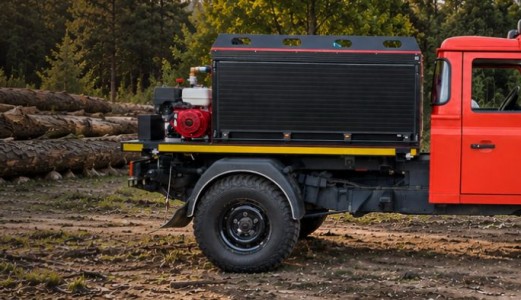
Unlike a fire engine, where the pump is driven by the truck's own engine and achieves higher hydraulic output, a portable pump has its own independent engine. That makes it transportable on foot, in a backpack, in a light vehicle, or even by helicopter. That's why it's the reference equipment for wildfires with limited or no vehicle access, hard-to-reach areas such as ravines or mountains, support for volunteer fire crews with limited resources, and hydraulic relay pumping, when a long hose lay reaches the pressure limit of the fire engine and there's no way to position another truck further along the line.
| Portable pump | Fire engine | |
|---|---|---|
| Engine | Self-contained, independent | The truck's own engine |
| Transport | On foot, backpack, vehicle or by helicopter | Heavy vehicle |
| Access | Trackless areas, mountains, woodland | Requires a passable route |
| Water supply | External source (pond, river, external tank…) | Own tanker, ~3,000 litres |
| Hydraulic output | Lower | Higher, direct engine coupling |
| Typical use | Relay pumping, direct feed, remote first attack | Direct attack, structural support |
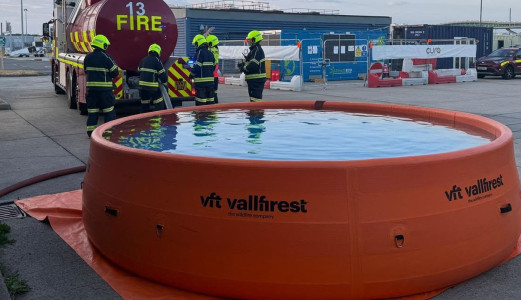
The two pieces of equipment are complementary: in many operations the fire engine carries water to an access point, and the portable pump drives it onward to where the truck can't reach.
Pressure, flow and head loss: what determines real reach
This was one of the topics we worked on most during the training in Colombia, because it's the one that raises the most doubts on the ground: how many hose lengths can be laid before losing useful pressure at the nozzle.
Some reference figures:
- The minimum pressure at the nozzle for a proper stream is 6 bar.
- With 25 mm hose, head loss is approximately ~1 bar per 20 m section (at flow rates of 100–150 l/min).
- With 45 mm hose, the loss drops to just ~0.2 bar per 20 m section under the same conditions — up to 4–5 times less than with 25 mm.
- For every 10 metres of positive elevation, roughly 1 additional bar is lost (10 m of water column equals 1 bar).
Practical example: with a portable pump capable of driving 100 l/min at 16 bar, you could run a flat lay of 10 lengths of 25 mm hose (10 bar of loss), needing 6 bar / 100 l/min at the nozzle.
That's why, on long lays, it's recommended to use 45 mm hose for the initial approach sections, where the goal is simply to move water with minimal loss, and reserve 25 mm hose for the final sections, where mobility during the attack matters most.
Field configurations
Depending on how they're deployed, there are different portable pump configurations:
- Direct attack — a single pump draws water from the source and drives it straight to the front.
- Series or tandem pumping — several pumps are connected in series, each one boosting the pressure from the one before. This increases reach and the elevation that can be overcome, not the flow rate.
- Parallel pumping — several pumps discharge into a common manifold, combining flow rates before splitting them out again. This allows 2 or 3 lines to be fed with more flow and pressure than in direct attack.
Flow-selector nozzles
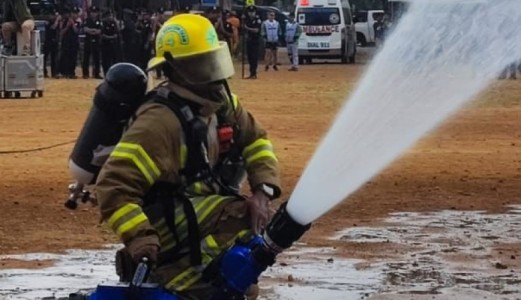
Nozzles with a flow selector let you match water consumption to the actual intensity of the fire front, avoiding waste and regulating pressure at the tip. Low-flow nozzles, between 20 and 100 l/min, are designed to work with high-pressure portable pumps, ensuring sufficient pressure even at reduced flow rates. High-flow nozzles, between 75 and 400 l/min, are aimed at higher-intensity fronts and self-protection manoeuvres, more common with fire engine set-ups and wide hoses (45–70 mm).
Best practices for handling and maintenance
During the training in Colombia we placed particular emphasis on preventive maintenance, key to making sure the equipment responds when it's needed most:
- Check before every use: fuel and oil levels, condition of fittings and seals, clean air filter.
- Correct priming of the pump, avoiding dry running.
- Filtered tank filling, always using the suction filter when drawing water from rivers or streams, to stop plant debris or ash clogging the system.
- Cleaning after every use, especially if water with sediment or brackish water has been pumped.
- Storage protected from the weather, with proper fuel management if the unit won't be used for several weeks.
- Scheduled periodic servicing by a specialised technical service.
A well-maintained unit doesn't just last longer — it also reduces the risk of failure at the critical moment of an emergency.
What the field teaches us
Understanding the hydraulic capacity of each portable pump, the right hose diameter, and the head losses affecting each set-up isn't a minor detail: it's what determines whether the water reaches the point where it's needed most with enough pressure. That's exactly what we saw working with the DNBC in Colombia, in departments where a vehicle simply isn't an option and everything depends on what a firefighter is able to carry on their back.
At Vallfirest we remain committed to ongoing technical training alongside our distributors and the fire services who trust our equipment, because a good product only delivers its full performance when the person using it truly knows it.
Already know what you need? In the next article we'll go through the Vallfirest range of portable pumps and how to choose the right model based on transport, flow rate and elevation.