
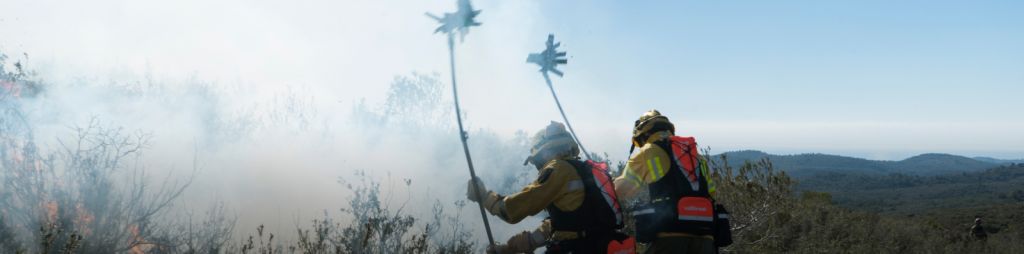
Are hand tools necessary to fight wildfires?
We use hand tools less and less. And that's a mistake.
Vallfirest was founded to bring solutions to wildfire suppression work. But we soon noticed something: in many countries these solutions weren’t understood, because certain manoeuvres simply weren’t known. There are regions that work almost exclusively with water, where a manoeuvre as simple as opening a fire break —a vegetation-free strip capable of holding a flank of the fire— is still barely known. Every country has developed its own way of fighting fire depending on the resources and knowledge available at each moment.
Today wildfires are changing: they are more intense, faster, and are emerging as a serious problem in areas where until recently they were almost anecdotal. Knowledge has to evolve at the same pace. That is why The Emergency Program, TEP was founded: to spread suppression knowledge beyond the borders of a single service, region or country.
And part of that knowledge is precisely the one most at risk of being lost: the knowledge of hand tools. The general trend is clear —more heavy machinery, more aerial resources, fewer hands with Gorguis on the ground— and it makes sense: machinery is faster and more powerful. But wildfire doesn’t always choose terrain a truck can reach.
That is exactly where hand tools remain irreplaceable. On steep slopes, rocky areas or spots with no forest track, they are the only resource able to get there —on foot or by helicopter— and act as a fuel break while heavy machinery is being mobilised, or when it simply cannot get in. That is why training in their use is not a nice-to-have: it is an operational necessity, and one of the pieces of knowledge TEP wants to help spread.
What are hand and power tools?
Hand and power tools are the oldest, most versatile, and still essential resource in wildfire suppression. They act directly on the fire triangle —fuel, oxygen and heat— through five basic technical actions: cutting, digging, raking, smothering and cooling. They are used both in direct attack on the flames and in indirect attack, removing fuel while building fire breaks. The great advantage of HMM manoeuvres over heavy machinery or a water line is agility: they can reach any point of the fire quickly, on foot or by helicopter, making them a key manoeuvre on steep terrain with no vehicle access.
In firefighting jargon, hand and mechanised tools covers all the portable equipment a wildland firefighter uses to physically intervene on the fire and the fuel: from a simple shovel to a chainsaw.
Their role is to act directly on one of the three elements of the fire triangle:
- Fuel – removing or modifying it (cutting, raking, digging).
- Oxygen – reducing its concentration (smothering).
- Heat – cooling down the burning material (water, scraping).
The 5 technical actions of hand tools
Before looking at each tool individually, it helps to understand what technical function it performs, since that determines its use in any manoeuvre:
| Technical action | What it achieves | Classic tools |
|---|---|---|
| Cutting | Removes vegetation and clears the way | Axe, machete, chainsaw |
| Digging | Digs down to mineral soil, removing roots and fuel residue that could carry fire across the fire break | Mattock, Pulaski |
| Raking / scraping | Clears surface organic matter | Forestry rake, McLeod |
| Smothering | Removes the oxidiser (oxygen) from the reaction | Fire swatter, shovel |
| Cooling | Reduces fuel temperature | Water backpack, atomiser |
As suppression services have become more professional, the market has evolved towards multi-function tools: a single head combining several of these actions, reducing the number of tools each firefighter has to carry and increasing performance on complex terrain. That is exactly the problem solved by the Vallfirest Gorgui, which combines in a single tool the functions of a McLeod (raking), a wide Pulaski or mattock (digging in organic soil) and a narrow Pulaski (digging in rocky soil).
The most widely used hand tools in wildfire suppression
Globally, practically every suppression service works with these eight tools:
- Pulaski — cutting and digging in a single tool.
- McLeod — digging and raking; ideal for raking and levelling the line.
- Gorgui — digging, cutting and raking in a single multi-function tool.
- Forestry rake — cutting and raking of light organic matter.
- Troop tool — combined cutting, digging, raking and smothering.
- Fire swatter — direct smothering of the flame.
- Water backpack — cooling and reduction of flame length.
- Shovel — smothering and cooling.
Added to these are power tools, engine-driven versions that speed up the work: chainsaws and brushcutters (cutting), and blowers, with or without water atomisation (smothering and cooling).
The 4 basic manoeuvres with hand and power tools
With a team combining cutting, digging and raking —and, where possible, smothering and cooling—, practically any basic suppression manoeuvre can be carried out:
1. Direct attack: the backpack-swatter pairing
The goal is to halt or stop the spread and stabilise the section of fire perimeter being worked. It consists of smothering the flames directly with fire swatters, extinguisher backpacks or improvised tools. It is the fastest and most effective manoeuvre with hand tools when flame length does not exceed roughly 1.5 m. It is typical in herbaceous fuels or low-intensity fuels. It can be carried out in linear mode (working the whole active perimeter) or point mode (stabilising only the most critical hot spots).
It is one of the most widespread working schemes among wildland crews worldwide, combining three roles with three tools:
- Water backpack — lowers flame length by spraying water on the front.
- Fire swatter — smothers the already-reduced flame, cutting off contact with oxygen.
- Digging/scraping tool (Gorgui, McLeod...) — drags the hot material towards the inside of the perimeter to prevent re-ignition.
This combination can be run with as few as two firefighters in its simplest form, or scaled up to five to work faster. The water backpack helps cool the fire first, lowering flame height, while the swatter behind it helps smother it. The choice of how many backpacks and swatters to use depends on the specific situation and fire behaviour. For example, in herbaceous fuels with relative humidity below 10%, the water backpack is essential because re-ignition is almost instant; at 40-60% humidity, a swatter and a light scrape are often enough.
2. Cutting a fuel break access lane
A manoeuvre consisting of clearing a line free of surface vegetation and, if needed, the tree canopy, in order to give access to the teams working behind it: for example, for hose lay operations, fire breaks or backfiring. It usually combines cutting hand tools such as the Gorgui, Pulaski, machetes, etc., or power tools such as the chainsaw (for cutting thick woody material like shrubs or even trees).
3. Clearing open or safety areas
Removes vegetation from an area to facilitate support operations: staging areas for fire engines, water points, or even emergency helicopter landing sites. The same cutting tools used for access-lane clearing are used here.
4. Fire break
This is the most complete manoeuvre: it removes all fuel down to mineral soil, creating a physical discontinuity between what will burn and what must remain untouched. It is carried out in three phases —access-lane clearing (if needed), trenching and berming—, and its minimum width depends directly on the expected flame length. Cutting, digging and raking tools are used.
In certain situations, the fire break is complemented with the use of prescribed fire: widening or fuel-break burns that remove fuel ahead of the active front, extending the discontinuity and reducing the manual workload. Hand tools are essential in this context, both to prepare the line from which the burn is set and to control the flanks of the burn once it has started.
Hand tools vs. water line vs. heavy machinery
No single resource replaces the others: they complement each other. This table summarises where each resource adds the most value:
| Resource | Strong point | Main limitation |
|---|---|---|
| Hand and power tools (HMM) | Maximum agility, access on foot or by helicopter to any terrain | Limited suppression capacity against intensities or flame lengths above 1.5 m |
| Water line | Great cooling capacity and reach | Depends on the hose lay and water supply |
| Heavy machinery | Maximum speed and capacity against high flame lengths (up to ~8 m) | Slow to get into position; limited by slope and access |
That is why advanced manoeuvres almost always combine HMM with a water line, aerial resources or heavy machinery: for example, a hand-tool crew positioned ahead of a water line to stabilise the most critical points, or behind it to mop up any hot spots left after the nozzle team has passed.
However, there are more agile alternatives to heavy machinery. This is the case of the Vallfirest Dronster: a remote-controlled, robotic forestry mulcher able to operate in terrain a tractor cannot reach. Unlike hand crews, it does not tire, and it can complement human work in dense fuels or hard-to-reach areas.
So, are hand tools necessary to fight wildfires? The answer is yes.
Hand tools are not a relic of the past: they are often the only resource able to reach places neither trucks nor machinery can access. The Pulaski, the McLeod, the Gorgui or a simple shovel remain decisive when the terrain is steep, when an immediate response is needed, or when fire intensity still allows it.
The challenge is not choosing between hand tools and machinery, but knowing how to combine them according to terrain, fuel and the stage of the fire. And that is only possible if training and knowledge of the basic manoeuvres —direct attack, access-lane clearing, clearing of open areas, fire breaks— stay alive, because no crew can make the most of a tool it doesn’t know how to use.
At Vallfirest we will keep working so that this knowledge is not lost, nor kept locked within the borders of a single country or suppression service. That is precisely why we support TEP: so that manoeuvres that work in one territory can reach and help in another.
Frequently asked questions
What is the difference between a Pulaski and a McLeod?
The Pulaski combines a cutting function (axe) with a digging function (mattock), designed to open soil or cut roots in a single motion. The McLeod combines light digging with raking and surface levelling, and is more effective at clearing fine organic matter (leaf litter, duff, pine needles) than at digging hard or rocky soil.
Why use multi-function tools like the Gorgui instead of several individual tools?
Because they reduce the weight and number of tools each firefighter has to carry, without losing operational capacity. With a single multi-function tool, a small crew (2-3 people) can carry out almost all the basic manoeuvres that used to require a crew of 5 with specific tools.
When is it better to use hand tools instead of heavy machinery?
When the terrain is very steep and/or rocky, when fire intensity is low or moderate (herbaceous fuels, scattered scrub), or when an immediate response is needed while machinery is being mobilised, which can take several hours to arrive and get into position. However, not all machinery is heavy. The Vallfirest Dronster is a remote-controlled, robotic forestry mulcher that reaches where tractors can't, without replacing hand crews but complementing them.
What role does the water backpack play in a grassland fire?
It is decisive in low relative humidity conditions (below 10%), where any hot spot smothered with a fire swatter can reignite almost instantly. Spraying water ahead of the swatter reduces flame length, while spraying behind it prevents these reignitions in very low-humidity conditions.
Vallfirest's toolbox for hand-tool suppression
Since 2007, Vallfirest —the wildfire company— has designed hand tools specifically for wildfire suppression, not adaptations of agricultural or civil-works tools. The Gorgui was our first patented product, and remains today the reference multi-function tool for fire breaks. Alongside it, the vft PRO 20L extinguisher backpack covers the cooling function in direct attack.
You can see the full range in the Vallfirest hand tools section.